Charles Haddon Spurgeon (19 June 1834 – 31 January 1892) was a British Baptist minister, well known for his eloquent sermons, prolific writing, and his love of good cigars. Once accused by Dr. Dwight Pentecost of engaging in "sinful" activity by smoking, he famously replied:
“Well, dear friends, you know that some men can do to the glory of God what to other men would be sin. And notwithstanding what brother Pentecost has said, I intend to smoke a good cigar to the glory of God before I go to bed tonight. If anybody can show me in the Bible the command, ‘Thou shalt not smoke,’ I am ready to keep it; but I haven’t found it yet. I find Ten Commandments, and it’s as much as I can do to keep them; and I’ve no desire to make them into eleven or twelve."
In addition to his regular preaching services and charity work in London, Mr. Spurgeon published a number of daily devotionals. I thought it might be a worthy thing to begin a thread in honor of this venerable BOTL, sharing his brief messages which have been published under the title of "Faith's Checkbook."
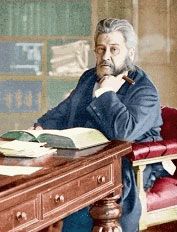 January 18
Christ and His ChildrenWhen thou shalt make his soul an offering for sin, he shall see his seed. (Isaiah 53:10)
Our Lord Jesus has not died in vain. His death was sacrificial: He died as our substitute, because death was the penalty of our sins. Because His substitution was accepted of God, He has saved those for whom He made His soul a sacrifice. By death He became like the corn of wheat which bringeth forth much fruit. There must be a succession of children unto Jesus; He is "the Father of the everlasting age." He shall say, "Behold, I and the children whom Thou hast given me."
A man is honored in his sons, and Jesus hath His quiver full of these arrows of the mighty. A man is represented in his children, and so is the Christ in Christians. In his seed a man's life seems to be prolonged and extended; and so is the life of Jesus continued in believers.
Jesus lives, for He sees His seed. He fixes His eye on us, He delights in us, He recognizes us as the fruit of His soul travail. Let us be glad that our Lord does not fail to enjoy the result of His dread sacrifice, and that He will never cease to feast His eyes upon the harvest of His death. Those eyes which once wept for us are now viewing us with pleasure. Yes, He looks upon those who are looking unto Him. Our eyes meet! What a joy is this!